MPAs in our Area
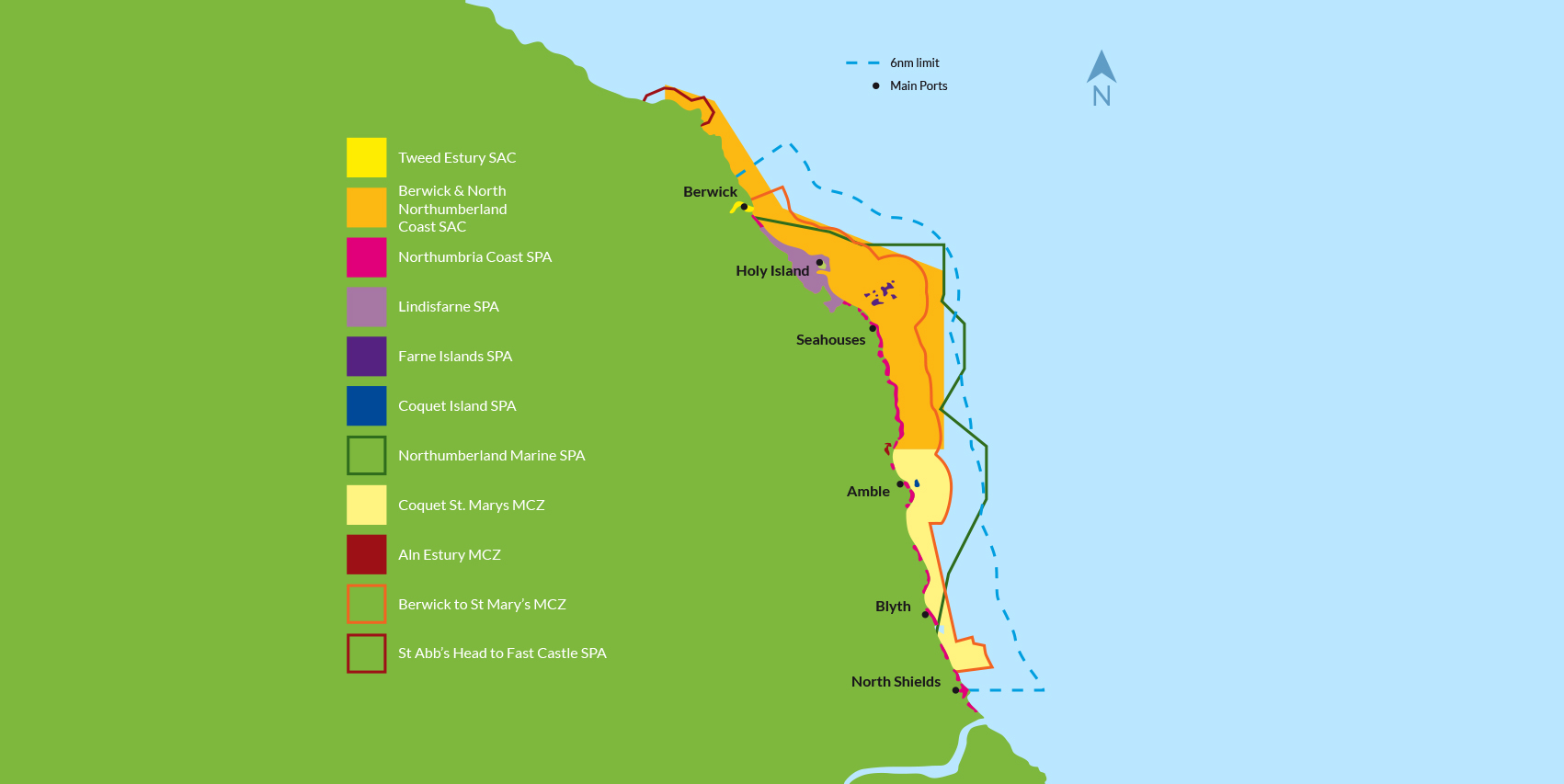
The Berwickshire and Northumberland Marine Nature Partnership is inviting applications for a new student bursary scheme. The scheme will award small grants of up to £300 for successful applications to help support dissertations undertaken by both undergraduate and post-graduate students. The prime criteria is that the geographical area covered by the dissertation must coincide, either totally or partially, with that of the Berwickshire and Northumberland Marine Nature Partnership (the River Tyne in England to Fast Castle Head in Scotland). The project would have to be on a coastal/marine topic or theme that furthers the knowledge base in the Marine Nature Partnership area.
Further details of the Scheme can be found in this flier
An application form, and details of our research priorities, can be found HERE
The closing date for applications is the 21st June 2024.
It is anticipated that the scheme will run annually with a future applications opening in March or April of each year.
June 8th is World Ocean Day the United Nation’s annual celebration of the ocean’s importance as the sustainer of all life on earth.

The theme of this year’s event is Planet Ocean: Tides are Changing and includes a call to action “Time to Put the Ocean First.”
The Berwickshire and Northumberland Marine Nature Partnership is the Coastal Partnership working to conserve and promote the sustainable use of the sea and estuaries from Fast Castle Head in Scotland down to the River Tyne in England. Action to conserve and restore the Ocean is fundemental to our remit. Below are some recent examples of our work:
Coastal Habitat Restoration: Thriving coastal habitats are important for nature, for livelihoods, and for wellbeing. They are also play a crucial role in building resilence to climate change and achieving Net Zero goals. Our coast supports many important habitats including saltmarsh, kelp forests, and seagrass beds but we need more, bigger and better marine and intertidal habitats. The Berwickshire and Northumberland Marine Nature Partnership are working with the Durham Heritage Coast Partnership to produce a Regional Coastal Habitat Restoration Plan covering Berwickshire and North East England. Using funding from the Environment Agency, we are holding workshops with partners to colloboratively identify restoration opportunities and priorities and pinpoint joint actions which our local community of marine practioners need to undertake to realise our ambitions. More details of this work can be found here
Later this year we will be also be commencing a project in North Tyneside and Northumberland to identify opportunities for retrofiting wildlife friendly features to hard coastal infrastructure such as seawalls.
Citizen Science and Data Collection: Good data is needed to inform management of our marine environment and to identify any changes taking place. As part of our Eider Aware Project we our collecting information from the public about the distution of Eider Ducks along our coast. This work supports a Natural England project to monitor Eider distribution within the Berwick to St Mary’s Marine Conservation Zone
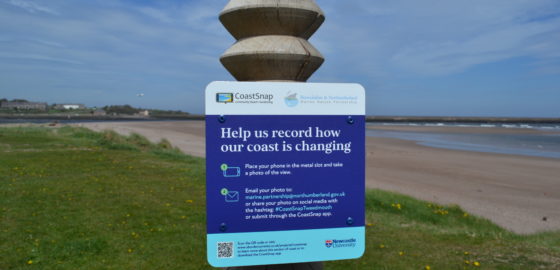
We are also work with Natural England and with volunteers from Coast Care on an initiative to undertake rocky shore monitoring using an indicator species approach. Later this year we will also be launching Coast Snap – a citizen science project to monitor coastal change using fixed point photography.
Marine Invasive Non-Native Species: Invasive Non-Native Species (INNS) pose a potential threat to the health of our marine ecosystems and can cause significant economic costs to coastal businesses. We have been working with partners to produce a Marine INNS Strategy and Biosecurity Plan for our partnership area. This will review the current and future threats from marine INNS in our area, examine the main pathways for INNS introduction and spread, discusses biosecurity measures that can be taken to reduce the spread of marine INNS, and set out measures for reporting the presence of marine INNS and the steps to be taken when they are discovered. It will also provide a short action plan to inform future activity. The Document will be published later this year.
Advice and Codes of Conduct: This year we have launched our Wild Recreation Guide for the Berwickshire, Nortumberland and North Tyneside Coast. This provides headline messages which will allow visitors to safely and responsibly enjoy outdoor recreation in the area while avoiding impacts on the internationally important wildlife found here. We are also commissioning some short films to promote these measures to a wider audience. These should be available later this year.
Management of Marine Protected Areas: An important function of the Berwickshire and Northumberland Marine Nature Partnership is to help our members coordinate their management of the suite of inshore Marine Protected Areas found between the Tyne and Fast Castle Head. We act as a source of information and support to our members and hold regular meetings to bring people together to share information and issues. We also maintain and regularly review the Management Scheme for our inshore Marine Protected Areas.
The Berwickshire, Northumberland and North Tyneside coast is an increasingly popular location for outdoor recreation of all kinds. Access to the coast brings a wealth of health and wellbeing benefits but pressures from recreation can also impact on the important wildlife found there.
We have produced the Wild Recreation Guide to provide headline messages which will allow visitors to safely and responsibly enjoy outdoor recreation in the area while avoiding impacts on the internationally important wildlife found here. We hope that you ENJOY this wonderful coastline, RESPECT other people, and help PROTECT the wildlife that makes the area so special.
The Guide can be accessed at https://www.xbordercurrents.co.uk/documents-and-links/wild-recreation-guide/
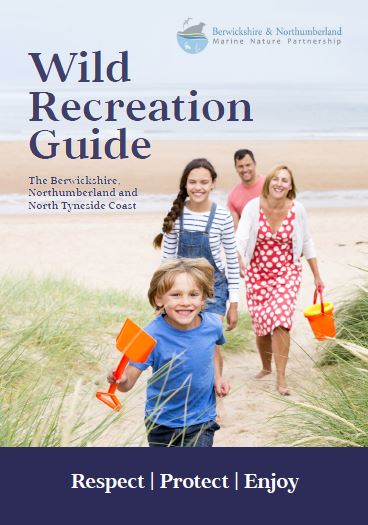
Many thanks to the Wash and North Norfolk Marine Partnership for allowing us to adapt the concept and their original Wild Recreation Guide and to Northumberian Water for support with the costs of document design.
Defra have launched a consultation is to seek views on the proposals to designate a number of candidate Highly Protected Marine Areas (HPMAs) in English waters.
HPMAs are areas of the sea that allow the protection and full recovery of marine ecosystems. HPMAs are defined in the Benyon review and government response as “areas of the sea that allow the protection and recovery of marine ecosystems by prohibiting extractive, destructive and depositional uses and allowing only non-damaging levels of other activities to the extent permitted by international law”. By setting aside some areas of sea with high levels of protection, HPMAs will allow nature to recover to a more natural state, allowing the ecosystem to thrive.
The five candidate HPMAs include a site at Lindisfarne on the inshore Northumberland coast.
The consultation can be found at https://consult.defra.gov.uk/hpma/consultation-on-highly-protected-marine-areas/
The closing date for comments is 29th September 2022.
Earlier this year the Berwickshire and Northumberland Marine Nature Partnership and the Durham Heritage Coast Partnership received funding from the Environment Agency’s Championing Coastal Coordnation (3Cs) initiative to run a joint project looking at our local response to the predicted climate change impacts on our coast.
The Project comprised workshops, evidence gathering, data analysis and a final event. These activities were led for us by The Blooming Platypus, involved 68 stakeholders from 41 organisations, and led to the production of a final Action Plan.
The final Project Report and Action Plan are now available to view online and can be found HERE
Our work formed part of a larger national-level 3Cs-funded project led by the Coastal Partnerships Network
We work regularly with our partners to develop individual projects to address specific issues or management needs on marine protected areas.
Take a look at our most recent project or view all of our projects.